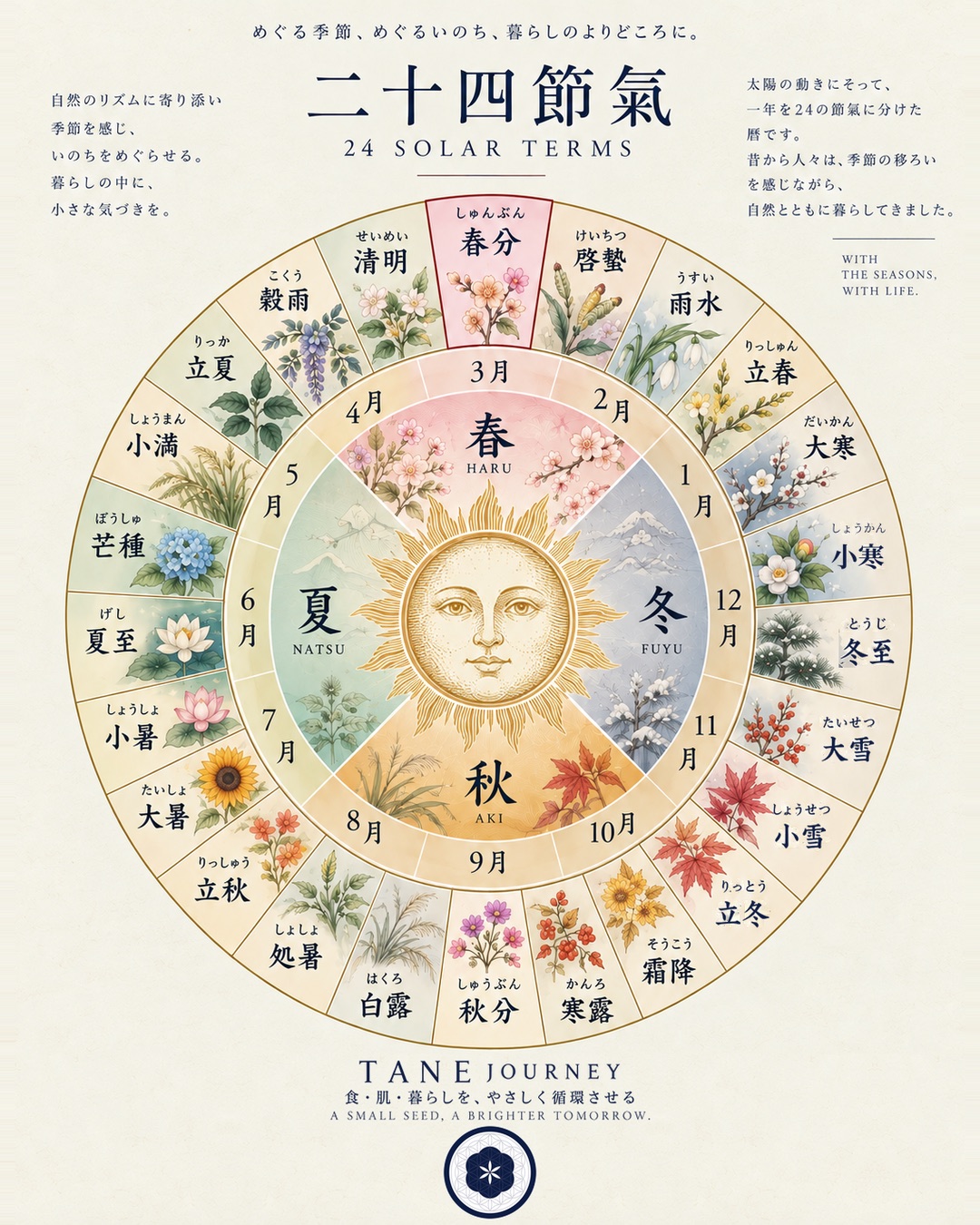
The twenty-four solar terms: 24 markers for reading a year.
The twenty-four solar terms (二十四節氣, nijushi sekki) are markers of the seasons that were born in China and also came to Japan. Based on the sun’s apparent movement over a year, they divide spring, summer, fall and winter into six each ── 24 turning points in all.34
Risshun, Shunbun (春分, “spring equinox”), Geshi (夏至, “summer solstice”), Shubun (秋分, “fall equinox”), Toji (冬至, “winter solstice”).
These words, which may sound familiar, are each one of the twenty-four solar terms. A term comes around about every 15 days, and it can mean not only that one day but also the period until the next term.345
Kanro (寒露, “cold dew”), for example, is the time when cold dew forms on the grass. Kokuu (穀雨, “grain rain”) is a name tied to the spring rain that waters the grain.3
Once the meaning of a name is known, an ordinary rain or the morning dew becomes a clue for finding the season.
If “summer is June, July and August,” why is Rikka, the start of summer, in May?
The seasons of the calendar, and the seasons we feel
“It’s still cold, and it’s already Risshun?”
“The heat goes on, and the calendar says fall?”
Looking at the calendar, there are times when the name of the season and the heat or cold felt on the skin do not line up.
One reason is that there is more than one ruler for dividing the seasons.
The four seasons used in weather forecasts and elsewhere, and the four seasons of the twenty-four solar terms, begin and end at different times. Knowing this difference may make the phrase “by the calendar” (暦の上では) feel a little closer.
Setting the two kinds of four seasons side by side
The Japan Meteorological Agency divides the year into spring, March to May; summer, June to August; fall, September to November; and winter, December to February.16 In the traditional division by the twenty-four solar terms, on the other hand, Risshun, Rikka, Risshu and Ritto are the beginnings of the seasons.3
The months in the table are given in the calendar in use today (the new calendar). The dates of the solar terms shift a little from year to year, so they are shown here as approximate times.
In other words, “summer is June to August” and “summer starts at Rikka” are both ways of dividing the seasons, by different standards.
The twenty-four solar terms are seasonal markers based on the course of the sun
The twenty-four solar terms are not set by measuring the temperature on a given day. They are a system that places 24 markers on the seasons, based on the change in the sun’s position over a year as seen from the earth. Spring, summer, fall and winter each have six terms.3
Following the calendar’s summer, for example, gives this.
Rikka (立夏) → Shoman (小満) → Boshu (芒種) → Geshi (夏至) → Shosho (小暑) → Taisho (大暑)
Summer begins at Rikka, Geshi sits around its middle, and at Risshu, which follows Taisho, the year moves into fall. Summer in this sense does not fit neatly into the three months of May, June and July.
Alongside “is it hot or cold right now,”
“whereabouts in the turning of the year are we?”
Holding that one point of view becomes a way in to enjoying the calendar.
It is not only “it’s the old calendar, so it’s a month off”
The twenty-four solar terms have been used together with the old calendar. But the solar terms themselves are based on the position of the sun, not on the waxing and waning of the moon. In the old calendar (旧暦, kyureki), these markers of the sun were also used to keep the months and the seasons in step.34
Rather than remembering it as “the old calendar, shifted one month from today’s,” it becomes easier to follow when thought of this way: apart from the divisions of the months, there are markers of the seasons.
Was the old calendar set by the moon alone?
The old calendar once used in Japan was a lunisolar calendar (太陰太陽暦): it divided the months by the waxing and waning of the moon, and also used the twenty-four solar terms, based on the sun, to adjust the gap between the calendar and the seasons.
Counting the days by the moon, and knowing the place in the season from the sun.
Both kinds of marker were built into the old calendar.24
Smaller words for the seasons: the seventy-two ko.
Each solar term divided into three more gives the seventy-two ko (七十二候, shichijuni-ko). They put the changes of about every five days into short phrases of flowers, birds, insects, weather and the like. Laid over the observation of nature is also the way people of the time saw things.6
Learning one word of the calendar, and then going for a walk outside.
It can be enjoyed that way, too.
The twenty-four solar terms of the year
- 立春RisshunThe cold passes its peak, and signs of spring can be felt
- 雨水UsuiThe air turns mild, snow and ice melt into water, and snow turns to rain
- 啓蟄KeichitsuInsects that spent the winter in the ground come crawling out
- 春分ShunbunThe sun rises due east and sets due west, and day and night are almost equal
- 清明SeimeiAll things look full of life and clear
- 穀雨KokuuSpring rain falls and moistens the grains
- 立夏RikkaSigns of summer can be felt
- 小満ShomanAll things gradually grow and begin to fill heaven and earth
- 芒種BoshuRice and other grains (those with awns) are planted
- 夏至GeshiDaylight is at its longest
- 小暑ShoshoThe hot season sets in, around when the rainy season ends
- 大暑TaishoAround when the summer heat is at its height
- 立秋RisshuSigns of fall can be felt
- 処暑ShoshoAround when the heat eases
- 白露HakuroWhite dew rests on the grass
- 秋分ShubunThe middle day of the fall higan; day and night are almost equal
- 寒露KanroFall deepens, and cold dew forms on the wild grassesRead the Kanro page →
- 霜降SokoAround when frost falls
- 立冬RittoSigns of winter can be felt
- 小雪ShosetsuIt turns cold, and rain becomes snow
- 大雪TaisetsuSnow begins to pile up in earnest
- 冬至TojiThe day is at its shortest of the whole year
- 小寒ShokanThe start of kan, the cold season; the cold grows stronger
- 大寒DaikanThe cold reaches its height; the coldest time
The descriptions are from the National Astronomical Observatory of Japan, Ephemeris Computation Office, 「こよみ用語解説 二十四節気」.
How did people long ago use the calendar?
They read the sky, looked at the flowers, and sowed their seeds.
Looking at the sky and the clouds without instruments, and reading the weather from experience. This is called kanten-boki (観天望気, “watching the sky, reading the weather”).11
“A red sunset, fair weather the next day.” “A halo around the moon, rain.” A local meteorological observatory explains that some of these sayings have reasons behind them. Depending on the season and the place, though, they do not always hold.12
Flowers, birds and the snow on the mountains were signals, too.
“When the kobushi magnolia blooms, sowing in the rice seedbed begins.” “The cuckoo is calling, so sow the millet.” There are also places where people knew the time for sowing and rice planting from the shapes of the snow left on the mountains (yukigata, 雪形).1314
People long ago used both ── the turning points of the calendar, such as the solar terms and the zassetsu (雑節, “miscellaneous seasonal days”), and these signals from nature ── as guides for sowing and harvest.13
In the field, for thinking about the right time for the work.
Hachijuhachiya (八十八夜, “the eighty-eighth night”) for watching out for late frost. Hangesho (半夏生) as a guide for finishing the rice planting. Nihyakutoka (二百十日, “the two hundred and tenth day”), a season of many storms. These zassetsu are seasonal markers that supplement the twenty-four solar terms.3
Did you know: Hachijuhachiya and Nihyakutoka are calendar words born in Japan. In the Edo period, Shibukawa Shunkai (渋川春海), who remade the calendar, once left them out, but they were put back at the appeal of a ship captain from Ise.15
At home, for making things last.
Mushiboshi (虫干し, “airing against insects”): choosing a dry, clear day in summer or fall and letting air through clothes, books and tools. There was seasonal care for keeping off damp, insects and mold.7
In the kitchen, for carrying food forward.
Drying food, or packing it in salt, to keep it for a long time. In dried foods and umeboshi there is the wisdom of carrying a bounty that cannot be eaten all at once on to a later table.89
Watching nature change, and getting ready what will be needed next.
TANE thinks there is wisdom for daily life there that can still be received today.
There is no need to reproduce every method just as it was done long ago.
Starting from knowing “why was it done that way, at that time of year,” how about looking for a form that works in life today?
The same season, from more than one point of view.
Reading nature from the movements of the sun and the moon.
Tracing, through old writings and the observances of each region, the meanings people have entrusted to the seasons.
The Chinese classic 『黄帝内経』 (Huangdi Neijing), for example, records a view of caring for life (養生) that takes fall as the season of “gathering in,” and turns its eyes to how the heart is held as well. This is one way of thinking, in which the seasons and people’s lives have been read together.10
TANE KOYOMI also looks at traditional views of the body like this one, and at yin-yang and the five phases (陰陽五行), Kigaku (気学), astrology, and the myths and customs of each region.
We present each of them with its own background, without confusing what has been confirmed by science, what is recorded in old writings, and what is a reading handed down as lore or as symbol.
What cannot yet be explained and what does not exist are not the same thing. At the same time, the fact that something cannot be explained does not make it, right away, evidence of a mysterious force. What TANE wants to hold on to is standing between the two.
Read Our View →
How have people looked at the same nature, and what have they held dear?
Receiving those points of view, we go on looking for ways of taking them in that mean something to each of us.
Finding the seasons of your own land.
The words of the calendar and the scenery of the place where you are now are not always the same.
The twenty-four solar terms were born in the north of ancient China, and the climate their words describe does not necessarily match the climate of Japan today.4 How the season actually looks also changes with the region, the elevation, the distance from the sea, the weather of that year, and more.
The seventy-two ko, too, have a history: the words that came from China have been revised to fit the climate and the living things of Japan.6
That is why TANE does not want to make the calendar into a rule ── “from this day, this is how one must live.”
When Risshun comes, looking for swelling buds along the usual road.
When Risshu comes, turning the eyes to the evening light and the wind.
If no change can be found yet, that too is the season of the place where you are.
And then carrying those small observations into today’s choice of clothes, the table, the way the home is kept.
In your land, what is in bloom now?
What foods are on the stands, and how does the morning air feel?
Not fitting life to the calendar, but getting to know one’s own land with the calendar as a clue.
Knowing the calendar, and valuing one’s own senses. From both, finding the way of choosing that fits life now.
TANE KOYOMI does not teach the right answer about the seasons. It hands on small markers for noticing how nature and daily life are connected.
After getting to know the calendar, one thing in daily life today.
Eating and drinking
Choosing one thing that is being harvested nearby now. Brewing a warm tea and slowly taking in its scent and taste. From seasonal ingredients and a cup for the season, we look for ways to enjoy the calendar at the table.
Putting up and growing
Drying a little food. Growing koji. Putting up miso. Coming to know not only how to make it, but why that ingredient is chosen and what to watch while waiting. From putting the hands to work, we find our own way of living with food.
Turning the eyes to home and skin
Taking out one piece of clothing and checking its condition. Touching the skin in the morning and thinking about today’s care. With the calendar as the occasion, we check the state of the room and our own senses, and choose one thing that is needed.
Looking at one’s own time
What do I want to hold dear now? What do I want to have a little less of, and what do I want to carry into the next season? We make the turning point of a season a small occasion to ask ourselves.
There is no need to do all of it.
A single cup of tea, a single act of care. We hope you will begin from wherever fits your life now.
Look for seasonal food and handwork →
For “I’d like to try it,” and for “I’d like to know more.”
Trying it in daily life|TANE
On to seasonal food, fermentation, handwork, and the care of skin and home. Trying one thing that has been learned, and finding the form that fits one’s own life.
See recipes, handwork and learning →
Choosing ingredients and tools for yourself
What is it made from? Where was it grown, and who made it, and how? Before introducing a product, we check together what is worth looking at when choosing. We also value ways that can be done with what is already at hand.
See how we choose ingredients and tools →
Tracing where the wisdom comes from|HALE
When and where was that custom born? What do the old writings say, and how was it handed down in other lands? HALE traces the background of knowledge ── the original texts and sources, the differing accounts, and even what is not yet known.
Each time the season turns, a small noticing in daily life.
Noticing a flower on the usual road.
The way of choosing ingredients changes a little.
Tasting, with someone, what has been put up.
Layering small experiences like these into one’s own life.
And handing the wisdom one has come to like on to family, and to the next person.
May knowing the calendar become a small beginning for choosing for yourself, and making for yourself.
TANE JOURNEY
Food, skin, and daily life — kept gently in circulation.
Sources
- National Diet Library, 「日本の暦:はじめに」 (The Japanese Calendar: Introduction) https://www.ndl.go.jp/koyomi/introduction/index.html
- National Diet Library, 「暦の渡来と普及」 (The arrival and spread of the calendar) https://www.ndl.go.jp/koyomi/chapter1/s1.html
- National Astronomical Observatory of Japan, Ephemeris Computation Office, 「こよみ用語解説 二十四節気」 (Calendar terms explained: the twenty-four solar terms) https://eco.mtk.nao.ac.jp/koyomi/faq/24sekki.html
- National Astronomical Observatory of Japan, 暦Wiki, 「季節/二十四節気とは?」 (Seasons / What are the twenty-four solar terms?) https://eco.mtk.nao.ac.jp/koyomi/wiki/B5A8C0E12FC6F3BDBDBBCDC0E1B5A4A4C8A4CFA1A9.html
- National Astronomical Observatory of Japan, 暦Wiki, 「季節/二十四節気の定め方」 (Seasons / How the twenty-four solar terms are set) https://eco.mtk.nao.ac.jp/koyomi/wiki/B5A8C0E12FC6F3BDBDBBCDC0E1B5A4A4CEC4EAA4E1CAFD.html
- National Astronomical Observatory of Japan, 暦Wiki, 「季節/七十二候」 (Seasons / The seventy-two ko) https://eco.mtk.nao.ac.jp/koyomi/wiki/B5A8C0E12FBCB7BDBDC6F3B8F5.html
- Nara National Museum, 「正倉院展用語解説:曝涼」 (Shoso-in Exhibition glossary: airing) https://shosointen-glossary.narahaku.go.jp/bakuryo/
- Ministry of Agriculture, Forestry and Fisheries of Japan, 「乾物」 (Dried foods) (aff, September 2019 issue) https://www.maff.go.jp/j/pr/aff/1909/spe2_01.html
- Ministry of Agriculture, Forestry and Fisheries of Japan, 「昔ながらの保存食!梅干し」 (A preserved food from long ago: umeboshi) https://www.maff.go.jp/j/zyukyu/foodstock/imadoki/imadoki07.html
- 『黄帝内経 素問』四気調神大論 (古诗文网) https://m.gushiwen.cn/guwen/bookv_bc64b64d257b.aspx
- 精選版 日本国語大辞典, 「観天望気」 (Kotobank) https://kotobank.jp/word/%E8%A6%B3%E5%A4%A9%E6%9C%9B%E6%B0%97-49321
- Akita Local Meteorological Observatory, 「天気のことわざ」 (Weather sayings) https://www.data.jma.go.jp/akita/knowledge/kotowaza/kotowaza.html
- 加藤・田淵 (2016), 『農業および園芸』 Vol. 91, No. 10 (Ministry of Agriculture, Forestry and Fisheries of Japan, AgriKnowledge) https://agriknowledge.affrc.go.jp/RN/2030910094.pdf
- Azumino City, 「雪形」 (Yukigata, snow shapes) https://www.city.azumino.nagano.jp/soshiki/32/10316.html
- National Astronomical Observatory of Japan, 暦Wiki, 「雑節とは?」 (What are the zassetsu?) https://eco.mtk.nao.ac.jp/koyomi/wiki/B5A8C0E12FBBA8C0E1A4C8A4CFA1A9.html
- Japan Meteorological Agency, 「予報用語:時に関する用語」 (Forecast terms: terms about time) (the periods of spring, summer, fall and winter) https://www.jma.go.jp/jma/kishou/know/yougo_hp/toki.html
Checked on: 2026-10-01 (10 on 2026-09-29; 16 on 2026-10-02)